Synopsis: UCL — The Governed Context Substrate for Enterprise AIOne substrate unifying BI, ML, RAG, and Agent consumption models
1. The Context Problem
Enterprise AI is stuck.
Not because models aren't capable. Not because compute is expensive. Because context — the enterprise data and signals that agents need to make real decisions — is fragmented, ungoverned, and inaccessible.

The fragmentation is structural:
ERP knows orders, invoices, and shipments
Process mining (Celonis, Signavio) knows cycle times, variants, and bottlenecks
EDW knows historical trends and aggregates
CRM knows customers, opportunities, and interactions
Feature stores know ML signals and embeddings
Web data knows market context and external signals
No system assembles the full picture. Each source speaks its own language. The "customer" in one system doesn't match the "customer" in another.
Traditional BI compounds the problem:
Dashboard sprawl with no provenance. The "two revenues" problem — finance and sales report different numbers. Quarter-end reconciliation requires tribal knowledge. Silent data errors propagate for weeks. Poor MTBF. Audit preparation takes 6 weeks instead of 10 days.
Today's agents inherit these gaps:
Agents follow hardcoded scripts in workflows. They cannot analyze situations because they lack situation context. They cannot determine the basis for next steps because the signals are scattered. Write-back to production systems has no contracts, no rollback, no evidence trail.

Industry data confirms the pattern:
Evidence | Source |
30% of Gen-AI projects abandoned | Quality issues, unclear value |
80% of AI projects fail to reach production | Only 48% deploy within ~8 months |
70% cite data integration as top barrier | Gen-AI at scale blocked by context |
63% cite output inaccuracy as top risk | Grounding failures |
35-38 week retrofit delays | Skipping governance up front costs ~2× |
These aren't operational problems. They're architectural gaps.
2. The UCL Concept
UCL — the Unified Context Layer — is an operational substrate that closes these gaps.
UCL is not an application. It is not a copilot. It is the governed infrastructure layer that makes applications and copilots possible.
The Core Insight:
UCL treats context as a governed product — versioned, evaluated, and promoted like code. Bad context doesn't reach production. Good context is assembled, governed, and served to every consumption model through a single substrate.
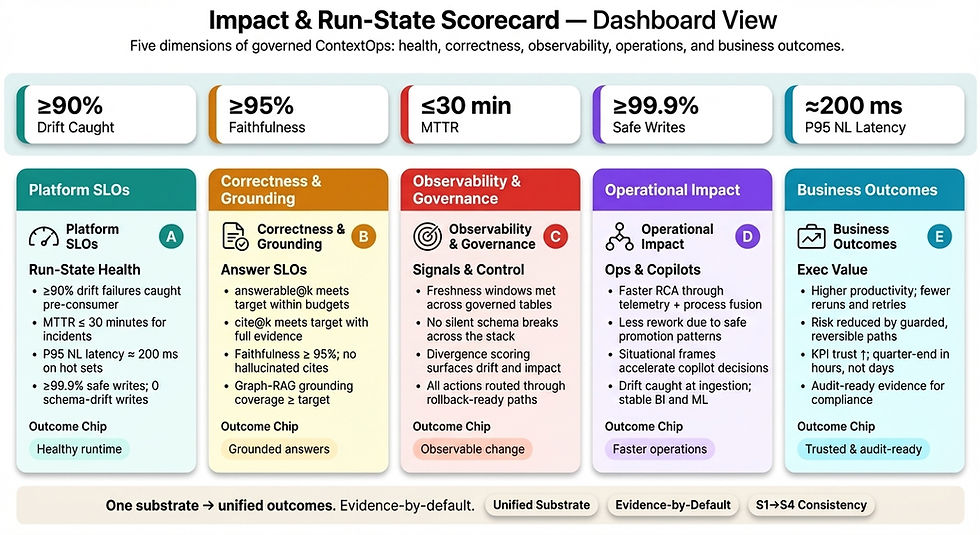
The UCL Position:
Layer | Role |
Autonomous Agents & Copilots | Reasoning, scoring, decision, action execution |
UCL | Governed context + activation infrastructure |
Data Platforms | Compute, storage, native capabilities |
UCL enables; copilots act. UCL does not replace agents — it gives them something coherent to reason over and a governed path to act through.
What UCL Does:
Capability | What It Means |
Unifies fragmented context | ERP + process mining + EDW + CRM + features + web data → one governed layer via process-tech fusion |
Provides common semantic layer | One KPI/entity spec shared across BI, ML, RAG, agents — no semantic forks |
Enables prompt-based visualization | NL query → governed KPI → dashboard; authoring without sprawl |
Exposes knowledge graph for reasoning | Meta-Graph enables graph-RAG — LLMs traverse entities, KPIs, lineage |
Enables situation analysis | Agents receive pre-scored situational frames — drivers, constraints, action candidates |
Evaluates before serving | Context Packs pass answerable@k, cite@k, faithfulness gates in CI |
Governs the activation path | Write-back through pre-write validation, schema authority, rollback recipes |
One Substrate, Five Consumption Models:

Model | What It Serves | UCL Contribution |
S1: BI / Cubes / NL Q&A | Dashboards, reports, natural language queries | Governed KPIs, prompt-based visualization (NL → dashboard), P95 ≈200ms |
S2: ML Feature Tables | Training and serving features | Same lineage as S1 KPIs, drift/skew gates, reproducible sets |
S3: RAG / Context Packs / KG | Retrieval-augmented generation | Graph-RAG + evaluated packs (faithfulness ≥95%), citations |
S4: Agent Situational Frames | Copilot decision context | Pre-scored situations, policy/budget compliance, action candidates |
Activation: Reverse-ETL | Write-back to ERP/CRM/Service | Pre-write validation, idempotent keys, rollback ≤5 min |
Define once, serve everywhere — same contracts, same semantics, same governance across all five consumption models.
Where UCL Fits in the Enterprise AI Landscape:
Data platforms (Snowflake, Databricks, Redshift) provide compute, storage, and native capabilities
Context engineering transforms raw data into governed, evaluated bundles
Common semantic layer ensures one KPI truth across all consumers
Meta-Graph (knowledge graph) enables graph-RAG and metadata reasoning — LLMs navigate enterprise semantics
Process-tech fusion unites ERP facts with process mining signals
Autonomous agents consume this governed context to analyze situations and act through governed channels
UCL is the substrate that connects these layers. Without UCL, each operates in isolation. With UCL, they form a coherent stack.
The Distinction:
Semantic layers stop at BI
RAG frameworks ignore enterprise contracts
Process mining tools don't fuse with ERP semantics
Reverse-ETL vendors have no upstream governance
UCL provides a common semantic layer across all consumption models — same KPIs, same contracts, same lineage, same governance — from prompt-based dashboard to agent action.
3. Six Paradigm Shifts
These capabilities don't emerge from incremental improvements. They require fundamental architectural shifts.
UCL represents six such shifts from current practice:
Shift | From | To |
1. Context | Byproduct of pipelines — whatever falls out of ETL | Governed product with versions, evaluation gates, promotion through CI/CD |
2. Data Sources | ERP, process mining, EDW, web as separate silos | Unified via process-tech fusion + common semantic layer |
3. Metadata | Passive catalogs for human browsing | Knowledge graph (Meta-Graph) enabling graph-RAG and metadata reasoning |
4. Consumption | Separate semantics per model — BI, ML, RAG diverge | One substrate serves S1-S4 + Activation; no semantic forks |
5. Activation | Separate Reverse-ETL pipe bolted on, ungoverned | Completion of governed loop; write-back with contracts and evidence |
6. Agents | Hardcoded scripts — IF alert THEN action | Situation analysis enables understanding, evaluation, decision |
The dependency chain matters:
Without Shift 1 (context as product), there's nothing governed to serve
Without Shift 2 (unified sources), agents see fragments
Without Shift 3 (active metadata), LLMs can't reason over enterprise semantics
Without Shift 4 (unified consumption), each model diverges
Without Shift 5 (governed activation), insights don't become action
Without Shift 6 (situation analysis), agents remain script-followers
Shift 6 is the culmination. The Situation Analyzer is THE GATEWAY between agents and governed context — transforming hardcoded scripts into situation-responsive decisions. But it only works if Shifts 1-5 are in place.
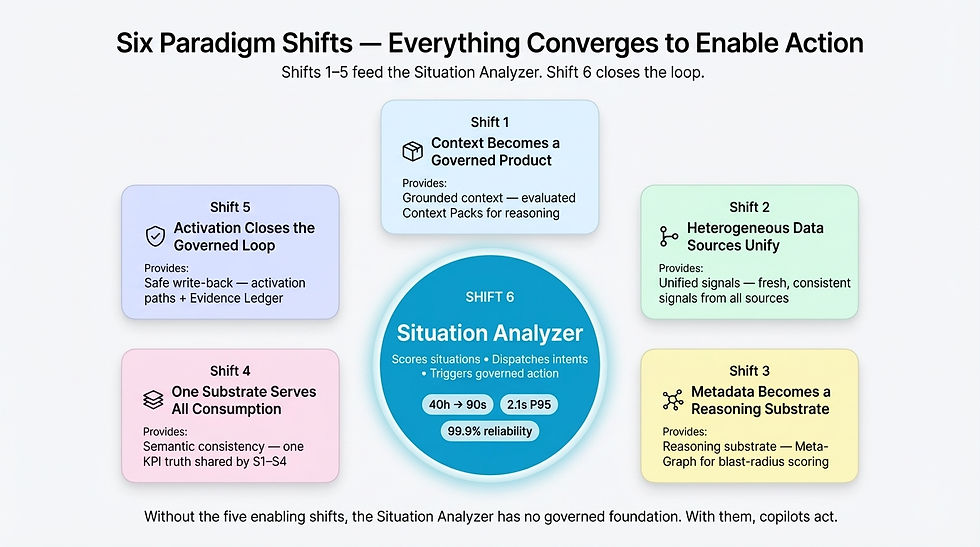
[GRAPHIC 1: Six Paradigm Shifts]
4. Why Agents Need UCL
But why do agents specifically need this substrate?
Because today's enterprise agents are artisanal builds on fragmented data — impressive demos, but incapable of serious work. The problem isn't model capability. It's that agents lack the infrastructure for enterprise-grade operation.
UCL closes five structural gaps:
Gap 1: Fragmented Context
The Problem: Enterprise context sits in pieces — ERP knows orders, process mining knows variants, EDW knows history, CRM knows customers, feature stores know ML signals. No system assembles the full picture.
What Agents Face: Each agent builds bespoke integrations to 2-3 sources. Different agents see different slices. Context is partial, inconsistent, ungoverned.
What UCL Provides: One governed substrate that unifies all sources. Agents receive Context Packs — pre-assembled, semantically consistent, ready for reasoning.
Gap 2: Enterprise Data & Process Signals Unavailable
The Problem: The richest enterprise signals — process variants from Celonis/Signavio, ERP transactional state, supply chain telemetry, finance actuals — are locked in operational systems.
What Agents Face: Agents operate on what's easily available: a vector store of documents, a single API, a narrow database view. They miss the signals that matter most.
What UCL Provides: Process-tech fusion — Celonis/Signavio process signals joined with ERP/finance facts under governed contracts, exposed through the common semantic layer.
Gap 3: Hardcoded Rules Instead of Situation Analysis
The Problem: Agents follow hardcoded scripts: "IF alert THEN workflow." They don't analyze situations. Planning systems need to determine the basis for next steps — but how, without understanding the current situation?
What Agents Face: Every decision path is pre-wired. Agents can't evaluate whether this OTIF miss is a carrier issue or a warehouse bottleneck. They execute scripts, not decisions.
What UCL Provides: Situational frames — pre-scored context containing KPI state, drivers of variance, ruled-out factors, applicable constraints, and action candidates. Basis for next steps becomes explicit.
Gap 4: Metadata Locked in Catalogs, Not Reasoned Over
The Problem: Enterprises have rich metadata — KPI definitions, entity relationships, lineage, data quality rules, ownership. But it sits in catalogs designed for human browsing, not LLM reasoning.
What Agents Face: Agents can't ask "which KPIs are affected by this table?" or "what's the lineage of this metric?" The knowledge exists but isn't accessible.
What UCL Provides: Meta-Graph — a knowledge graph of entities, KPIs, lineage, contracts, and usage patterns. Enables graph-RAG: agents traverse relationships, ground retrieval in enterprise semantics, reason over structure — not just text.
Gap 5: Operational Gaps in DataOps & Correctness
The Problem: Enterprise-class operations require drift detection, freshness monitoring, schema validation, fail-closed gates, and auto-recovery. Most agent architectures ignore this.
What Agents Face: Agents consume stale data without knowing it. Schema changes break pipelines silently. Drift propagates for weeks. No contracts, no gates, no rollback.
What UCL Provides: Governed ContextOps — contracts-as-code, drift/freshness monitoring, CI gates that block bad context, auto-rollback to last-good state.
Summary: Five Gaps, One Substrate
Gap | Without UCL | With UCL |
Fragmented context | Partial, inconsistent slices | Unified Context Packs |
Enterprise data unavailable | Locked in operational systems | Process-tech fusion exposes full surface |
Hardcoded rules | Scripts execute, don't decide | Situational frames enable analysis |
Metadata not reasoned over | Catalogs for humans | Meta-Graph for LLM traversal |
Operational gaps | Assume data is correct | Governed ContextOps with gates |
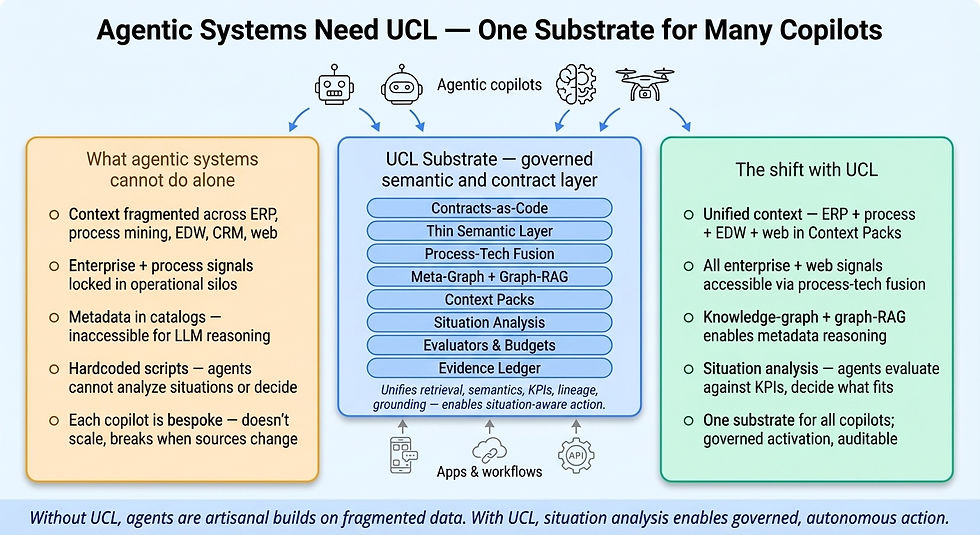
[GRAPHIC 2: Agentic Systems Need UCL — One Substrate for Many Copilots]
5. Architecture
UCL implements through a four-plane architecture with eight patterns.
The Four Planes
Plane | Function | Key Components |
Situation Analysis | THE GATEWAY — where agents meet governed context | Intent normalization, situation scoring, pre-action checks |
Control | Governance enforcement | Contracts-as-Code, separation of duties, DAG orchestration, safe routing |
Metadata | Enterprise knowledge | Meta-Graph, Evidence Ledger, observability bus |
Data/Serving | Operations and consumption | Ingestion, semantic layer, process fusion, S1-S4 serve ports, activation |
Pattern 8: The Gateway
All agent interactions pass through Pattern 8 (Situation Analyzer). Agent requests descend; Context Packs ascend. This choke point ensures every agent interaction is:
Contextualized — full situational frame, not fragments
Evaluated — scored against KPIs, constraints, policies
Governed — contracts enforced, lineage tracked
Auditable — evidence recorded for every decision
Platform Fit
UCL extends existing investments:
Platform Type | Examples | UCL Integration |
Data Platforms | Snowflake, Databricks, Redshift, Fabric | UCL adds contracts, semantics, context layer |
Process Mining | Celonis, Signavio | Signals fused into Meta-Graph and Context Packs |
Agent Orchestration | LangChain, n8n, custom copilots | Consume Context Packs, use activation infrastructure |
Observability | Monte Carlo, Datadog | Feeds UCL drift/freshness monitoring |
No rip-and-replace. UCL operates as a semantic + context plane above existing infrastructure.

[GRAPHIC 3: UCL Substrate Architecture — The Agentic Gateway]
6. What Becomes Possible
With UCL deployed, capabilities shift:
Capability | Without UCL | With UCL |
Agent decision-making | Hardcoded scripts | Situation analysis and autonomous decision |
Context assembly | Each copilot builds its own | Governed Context Packs from common semantic layer |
RAG quality | Text retrieval, ships without evaluation | Graph-RAG + evaluated packs (faithfulness ≥95%) |
Dashboard creation | Manual builds, sprawl | Prompt-based visualization with governance |
Write-back safety | Schema drift, no rollback | Pre-write validation, rollback ≤5 min |
Process + finance fusion | Separate systems, manual joins | Process-tech fusion; same-day RCA |
Metadata access | Catalogs for humans | Knowledge graph for LLM reasoning |
Drift detection | Caught at inference (weeks late) | Caught at ingestion (immediate) |
Industry Validation
These patterns have demonstrated results:
Pattern | Evidence |
Closed-loop activation (governed outputs → Reverse-ETL) | CAC improvement 15-30%, conversion lift 25-45% |
Context engineering + process-tech fusion | 30% lower abandonment, 60% faster decisions, MTTR 12h→3h |
Grounded RAG with evaluation gates | Inaccuracy risk (63% cite it) reduced through faithfulness gates |
Governed ContextOps | ~70% fewer silent errors, audit prep 6 weeks→10 days |
The Transformation
The gap between enterprise data and enterprise action has persisted because no substrate unified context across consumption models.

UCL closes that gap.
Agents move from scripts to situations. Dashboards move from displays to decisions. Copilots move from impressive demos to production systems capable of serious work.
Define once, serve everywhere. Build once, consume everywhere. The last mile finally connects.
UCL — Governed Context for Enterprise AI
Arindam Banerji, PhD


Comments